 |
Documentation of UrbanFireXDT
Documentation of UrbanFireXDT
|
Loading...
Searching...
No Matches
|
Documentation of UrbanFireXDT
Documentation of UrbanFireXDT
|
Definition and implementation of functions that connect the C++ simulation with Python via pybind11. More...
#include <atomic>#include <condition_variable>#include <mutex>#include <thread>#include <pybind11/pybind11.h>#include <pybind11/stl.h>#include "cache_helper.hpp"#include "components.h"#include "global.h"#include "setup_and_dataloading.h"#include "simulation_logic.h"#include "units.h"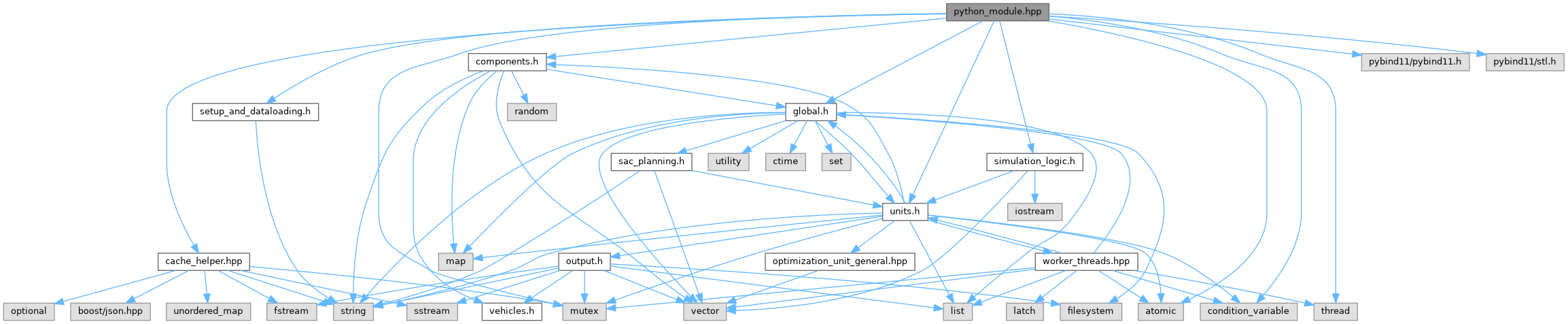
Go to the source code of this file.
Classes | |
| struct | pyconn::SimulationEVState |
| Represents the state of a single EV during a simulation time step. More... | |
| struct | pyconn::SimulationControlUnitState |
| Represents the state of a single control unit during a simulation time step. More... | |
Namespaces | |
| namespace | pyconn |
Functions | |
| void | pyconn::initialize_simulation (pybind11::dict args) |
| Initializes and starts the simulation from Python. | |
| unsigned long | pyconn::get_next_timestep_id () |
| Returns the timestep ID of the next time step. | |
| bool | pyconn::simulation_finished () |
| Checks if the simulation reached its end. | |
| SimulationControlUnitState | pyconn::getState (unsigned long controlUnitID) |
| Retrieves the state of a control unit. | |
| void | pyconn::sendCommands (unsigned long controlUnitID, pybind11::dict commands) |
| Sends a control command to a given control unit. | |
| void | pyconn::run_one_step () |
| Executes a single simulation time step. | |
| void | pyconn::reset_simulation_to_start () |
| Resets the simulation and all internal states to the first time step. | |
| void | pyconn::vacuum () |
| Cleans up the simulation, finished the working thread and releases resources. | |
Variables | |
| std::thread | pyconn::g_sim_worker |
| The worker thread for the simulation that is started by pyconn::initialize_simulation() | |
| std::atomic< bool > | pyconn::g_sim_started {false} |
| States if the working thread for the simulation has been started. | |
| std::atomic< bool > | pyconn::g_sim_finished {false} |
| States if the simulation has reached its final state (and cannot proceed anymore, or must be reseted to proceed) | |
| std::atomic< bool > | pyconn::g_simulation_main_part_started |
| Flag indicating whether the simulation has finished the SAC planning and addition. | |
| std::atomic< bool > | pyconn::g_simulation_idling |
| Flag indicating whether the simulation is currently idling or working. | |
| std::mutex | pyconn::g_mtx_simulation |
| Mutex protecting synchronization between the simulation thread and Python calls. | |
| std::condition_variable | pyconn::g_cv_sim_state_update |
| Condition variable to notify and to wait for changes in the simulation / python code state. | |
| std::atomic< bool > | pyconn::g_next_step_requested |
| Flag indicating that a new simulation step should be executed. | |
| std::atomic< bool > | pyconn::g_worker_threads_shutdown_cmd {false} |
| Flag indicating that all worker threads should shoutdown and the simulation should be finished. After that, no reset is possible anymore. | |
| std::atomic< unsigned long > | pyconn::g_atomic_next_tsID |
| Shared variable indicating the next time step ID to be executed when calling pyconn::run_one_step() | |
| std::atomic< bool > | pyconn::g_restart_simulation {false} |
| Flag indicating to restart the simulation after a reset of all internal states. | |
| float | pyconn::expansion_matrix_rel_freq [16][16] = {0} |
| Variable storing the expansion matrix with relative frequencies - if using as stand-alone simulation, this is placed inside main and no global variable. | |
| unsigned long | pyconn::expansion_matrix_abs_freq [16][16] = {0} |
| Variable storing the expansion matrix with absolute frequencies - if using as stand-alone simulation, this is placed inside main and no global variable. | |
| unsigned long | pyconn::scenario_id |
| Variable storing the selected scenario ID - if using as stand-alone simulation, this is placed inside main and no global variable. | |
Definition and implementation of functions that connect the C++ simulation with Python via pybind11.
This is a header-only file providing Python bindings to initialize, control, and finalize simulation runs from within Python.
 1.9.8
1.9.8