 |
Documentation of UrbanFireXDT
Documentation of UrbanFireXDT
|
Loading...
Searching...
No Matches
|
Documentation of UrbanFireXDT
Documentation of UrbanFireXDT
|
#include <components.h>
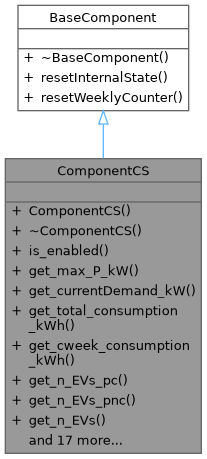
Public Member Functions | |
| ComponentCS (ControlUnit *calling_control_unit, unsigned int number_of_flats) | |
| Constructs a new Charging Station component. There will be one charging point per flat. | |
| ~ComponentCS () | |
| bool | is_enabled () const |
| double | get_max_P_kW () const |
| Returns the maximum available charging power for this station in kW (regardless if this is currently available, as some EVs might already be fully charged or not available) | |
| double | get_currentDemand_kW () const |
| Returns the current power in kW for the current time step. Only valid after the call of set_charging_value(). This value might differ from the request set using set_charging_value(). | |
| double | get_total_consumption_kWh () const |
| Returns the total consumed energy in kWh after the current time step. Only valid after the call of set_charging_value() | |
| double | get_cweek_consumption_kWh () const |
| Returns the total consumed energy in kWh after the current time step. Only valid after the call of set_charging_value() | |
| unsigned long | get_n_EVs_pc () const |
| Returns the number of EVs that are currently at home AND connected with the station. | |
| unsigned long | get_n_EVs_pnc () const |
| Returns the number of EVs that are currently at home AND NOT connected with the station. | |
| unsigned long | get_n_EVs () const |
| Returns the number of connected EVs if the component is enabled, otherwise 0 is returned. | |
| unsigned long | get_possible_n_EVs () const |
| Returns the number of possible connected EVs if the component would be enabled. | |
| unsigned long | get_control_unit_id () const |
| Returns the control unit ID of the installation place. | |
| std::vector< const EVFSM * > | get_listOfEVs () const |
| Returns a reference to the internal list of EVs. | |
| unsigned long | get_n_chargers () const |
| Returns the number of chargers available at this charging station (typically the number of flats of the building) | |
| const std::vector< const std::vector< double > * > * | get_future_max_consumption_kWh () const |
| const std::vector< const std::vector< double > * > * | get_future_min_consumption_kWh () const |
| const std::vector< const std::vector< double > * > * | get_future_max_power_kW () const |
| void | enable_station () |
| void | disable_station () |
| void | resetWeeklyCounter () |
| Resets the internal, weekly counters. | |
| void | resetInternalState () |
| Resets the internal simulation state (like counters), but retains the structural state like attached sub-components. | |
| void | add_ev (unsigned long carID) |
| void | set_horizon_in_ts (unsigned int new_horizon) |
| Sets another horizon for the number of time steps returned by ComponentCS::get_future_min_consumption_kWh() and ComponentCS::get_future_max_consumption_kWh() | |
| void | preprocess_ev_data () |
| Preprocesses EV data, calls EVFSM::preprocessTourInformation() for all attached EVs. Call this method only once right before the first simulation run. | |
| void | setCarStatesForTimeStep (unsigned long ts) |
| Sets the car states for all attached EVs for a new time step 'ts'. This method must be called with strictly consecutive values of parameter 'ts'. | |
| void | setDemandToProfileData (unsigned long ts) |
| Sets the charging demand to the (immediate charging) profile value. If this method is called once during a simulation run, ComponentCS::setDemandToGivenValues() MUST NOT be called afterwards. | |
| bool | setDemandToGivenValues (std::vector< double > &charging_power_per_EV_kW) |
| Sets the charging demand (in kW) per EV as given by any contoller. If this method is called once during a simulation run, ComponentCS::setDemandToProfileData() MUST NOT be called afterwards. Returns true if no error occured for all connected EVs or false otherwise. | |
 Public Member Functions inherited from BaseComponent Public Member Functions inherited from BaseComponent | |
| virtual | ~BaseComponent () |
This class represents a charging station. Every control unit holds a charging station by default, which is disabled. Enabling a station in the simulation represents to build such a station in the reality.
| ComponentCS::ComponentCS | ( | ControlUnit * | calling_control_unit, |
| unsigned int | number_of_flats | ||
| ) |
Constructs a new Charging Station component. There will be one charging point per flat.
| calling_control_unit | Reference to the calling unit, |
| number_of_flats | The number of flats connected to the charging station |
| ComponentCS::~ComponentCS | ( | ) |
| void ComponentCS::add_ev | ( | unsigned long | carID | ) |
| void ComponentCS::disable_station | ( | ) |
| void ComponentCS::enable_station | ( | ) |
| unsigned long ComponentCS::get_control_unit_id | ( | ) | const |
Returns the control unit ID of the installation place.
|
inline |
Returns the current power in kW for the current time step. Only valid after the call of set_charging_value(). This value might differ from the request set using set_charging_value().
|
inline |
Returns the total consumed energy in kWh after the current time step. Only valid after the call of set_charging_value()
|
inline |
Returns the maximum electricity consumption of this component for the next n time steps (given some flexibility). This means that the value at position 0 returns the maximum cummulated consumption AT THE END of the current time step. This method assumes to start in the current time step, i.e. the consumption up to the current time step is considered to be 0. The length of the resulting vector is set using ComponentCS::set_horizon_in_ts(). Attention: The object the returned pointer referes to is overwritten on subsequent calls!
|
inline |
Returns the maximum power per time step and EV for the future horizon. Attention: The object the returned pointer referes to is overwritten on subsequent calls!
|
inline |
Returns the minimum electricity consumption of a component for the next n time steps (given some flexibility). This means that the value at position 0 returns the minimum cummulated consumption AT THE END of the current time step. This method assumes to start in the current time step, i.e. the consumption up to the current time step is considered to be 0. The length of the resulting vector is set using ComponentCS::set_horizon_in_ts(). Attention: The object the returned pointer referes to is overwritten on subsequent calls!
|
inline |
Returns a reference to the internal list of EVs.
| double ComponentCS::get_max_P_kW | ( | ) | const |
Returns the maximum available charging power for this station in kW (regardless if this is currently available, as some EVs might already be fully charged or not available)
|
inline |
Returns the number of chargers available at this charging station (typically the number of flats of the building)
| unsigned long ComponentCS::get_n_EVs | ( | ) | const |
Returns the number of connected EVs if the component is enabled, otherwise 0 is returned.
| unsigned long ComponentCS::get_n_EVs_pc | ( | ) | const |
Returns the number of EVs that are currently at home AND connected with the station.
| unsigned long ComponentCS::get_n_EVs_pnc | ( | ) | const |
Returns the number of EVs that are currently at home AND NOT connected with the station.
| unsigned long ComponentCS::get_possible_n_EVs | ( | ) | const |
Returns the number of possible connected EVs if the component would be enabled.
|
inline |
Returns the total consumed energy in kWh after the current time step. Only valid after the call of set_charging_value()
|
inline |
| void ComponentCS::preprocess_ev_data | ( | ) |
Preprocesses EV data, calls EVFSM::preprocessTourInformation() for all attached EVs. Call this method only once right before the first simulation run.
|
virtual |
Resets the internal simulation state (like counters), but retains the structural state like attached sub-components.
Implements BaseComponent.
|
virtual |
Resets the internal, weekly counters.
Implements BaseComponent.
| void ComponentCS::set_horizon_in_ts | ( | unsigned int | new_horizon | ) |
Sets another horizon for the number of time steps returned by ComponentCS::get_future_min_consumption_kWh() and ComponentCS::get_future_max_consumption_kWh()
| void ComponentCS::setCarStatesForTimeStep | ( | unsigned long | ts | ) |
Sets the car states for all attached EVs for a new time step 'ts'. This method must be called with strictly consecutive values of parameter 'ts'.
| bool ComponentCS::setDemandToGivenValues | ( | std::vector< double > & | charging_power_per_EV_kW | ) |
Sets the charging demand (in kW) per EV as given by any contoller. If this method is called once during a simulation run, ComponentCS::setDemandToProfileData() MUST NOT be called afterwards. Returns true if no error occured for all connected EVs or false otherwise.
| void ComponentCS::setDemandToProfileData | ( | unsigned long | ts | ) |
Sets the charging demand to the (immediate charging) profile value. If this method is called once during a simulation run, ComponentCS::setDemandToGivenValues() MUST NOT be called afterwards.
 1.9.8
1.9.8