 |
Documentation of UrbanFireXDT
Documentation of UrbanFireXDT
|
Loading...
Searching...
No Matches
|
Documentation of UrbanFireXDT
Documentation of UrbanFireXDT
|
#include <components.h>
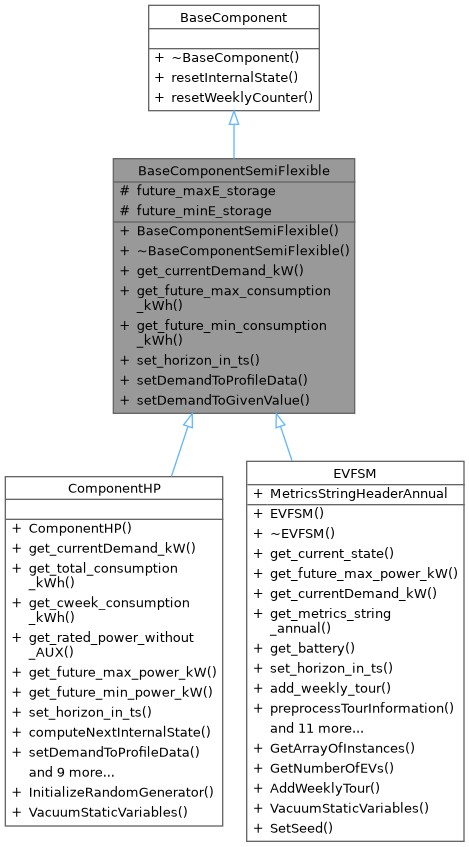
Public Member Functions | |
| BaseComponentSemiFlexible () | |
| ~BaseComponentSemiFlexible () | |
| virtual double | get_currentDemand_kW () const =0 |
| const std::vector< double > * | get_future_max_consumption_kWh () const |
| const std::vector< double > * | get_future_min_consumption_kWh () const |
| void | set_horizon_in_ts (unsigned int new_horizon) |
| virtual void | setDemandToProfileData (unsigned long ts)=0 |
| virtual bool | setDemandToGivenValue (double new_demand_kW)=0 |
 Public Member Functions inherited from BaseComponent Public Member Functions inherited from BaseComponent | |
| virtual | ~BaseComponent () |
| virtual void | resetInternalState ()=0 |
| Resets the internal simulation state (like counters), but retains the structural state like attached sub-components. | |
| virtual void | resetWeeklyCounter ()=0 |
| Resets the internal, weekly counters. | |
Protected Attributes | |
| std::vector< double > | future_maxE_storage |
| std::vector< double > | future_minE_storage |
An abstract class acting as super-class for all components that can be controlled, but still have to fulfil a task. An example would be a heat pump or an individual EV. Both offer flexibility to some extend, but their main purpose is to generate heat or to drive. Thus their control is semi-flexible, as the main purpose still has to be fulfilled.
Instead, a battery storage is a fully-flexible controlable element, as it has no other task to fulfil.
| BaseComponentSemiFlexible::BaseComponentSemiFlexible | ( | ) |
| BaseComponentSemiFlexible::~BaseComponentSemiFlexible | ( | ) |
|
pure virtual |
Implemented in ComponentHP, EVFSM, ComponentHP, and EVFSM.
|
inline |
Returns the maximum electricity consumption of a component for the next n time steps (given some flexibility). This means that the value at position 0 returns the maximum cummulated consumption AT THE END of the current time step. This method assumes to start in the current time step, i.e. the consumption up to the current time step is considered to be 0. The length of the resulting vector is set using BaseComponentSemiFlexible::set_horizon_in_ts(). Attention: The object the returned pointer referes to is overwritten on subsequent calls!
|
inline |
Returns the minimum electricity consumption of a component for the next n time steps (given some flexibility). This means that the value at position 0 returns the minimum cummulated consumption AT THE END of the current time step. This method assumes to start in the current time step, i.e. the consumption up to the current time step is considered to be 0. The length of the resulting vector is set using BaseComponentSemiFlexible::set_horizon_in_ts(). Attention: The object the returned pointer referes to is overwritten on subsequent calls!
| void BaseComponentSemiFlexible::set_horizon_in_ts | ( | unsigned int | new_horizon | ) |
Sets another horizon for the number of time steps returned by BaseComponentSemiFlexible::get_future_min_max_demand()
|
pure virtual |
Changes the (shiftable) demand of the component for the current time step. It must be called before the current demand and total consumption values are set correctly. If this function is called, BaseComponentSemiFlexible::setDemandToProfileData() must not be called anymore.
| new_demand_kW | The new power for this time step in kW. |
Implemented in ComponentHP, EVFSM, ComponentHP, and EVFSM.
|
pure virtual |
Sets the demand value to the value as given in the data. If this function is called, BaseComponentSemiFlexible::setDemandToGivenValues() must not be called anymore.
Implemented in ComponentHP, EVFSM, ComponentHP, and EVFSM.
|
protected |
Internal storage of an object that is outputted by BaseComponentSemiFlexible::get_future_max_consumption(), only required that we do not need to reserve / allocate a new vector with every call of BaseComponentSemiFlexible::get_future_max_consumption()
|
protected |
Internal storage of an object that is outputted by BaseComponentSemiFlexible::get_future_min_consumption(), only required that we do not need to reserve / allocate a new vector with every call of BaseComponentSemiFlexible::get_future_min_consumption()
 1.9.8
1.9.8